What Is End-to-End Encryption and Why Does It Matter?

Updated: Sep 19

Every day, people use messaging apps to share personal conversations, photos, documents, passwords, plans, and other sensitive information.
But what happens to a message after you press Send?
Does it travel directly to the recipient? Can the messaging service read it?
Is it stored somewhere? Could someone intercept it?
End-to-end encryption is designed to reduce these risks and keep conversations private.
What Is End-to-End Encryption?
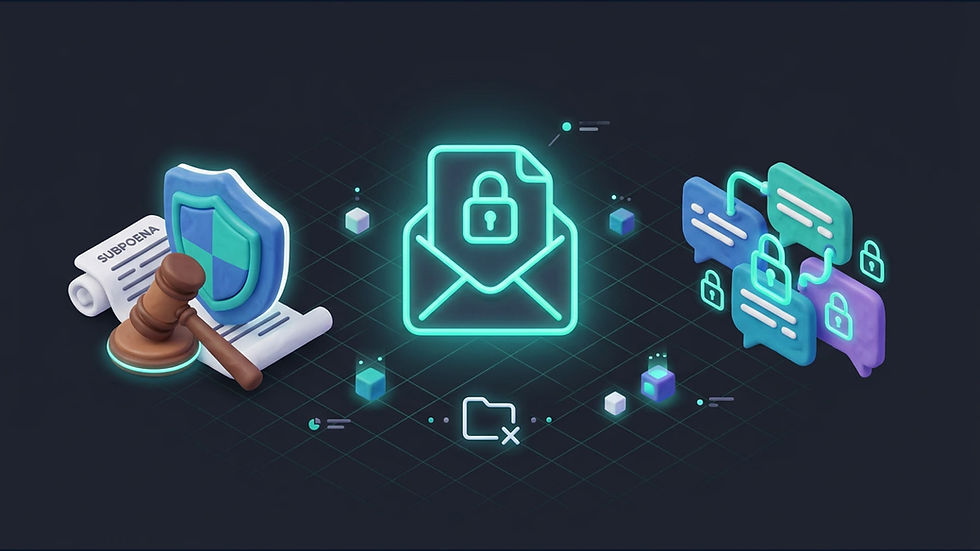
End-to-end encryption, often shortened to E2EE, is a method of protecting information so that only the sender and the intended recipient can read it.
Before a message leaves your device, it is converted into encrypted data.
This encrypted data travels through the internet and may pass through a messaging provider’s servers.
However, the message should only become readable again on the recipient’s device.
In simple terms:
You write a message.
Your device encrypts it.
The encrypted message is delivered through the messaging service.
The recipient’s device decrypts it.
Anyone who intercepts the encrypted data should see unreadable information instead of the original message.
How Is This Different from Regular Encryption?
Many online services use encryption while data is travelling between your device and their servers. This is commonly known as encryption in transit.
Encryption in transit helps protect information from people trying to intercept it over a network. However, the service provider may still be able to decrypt and access the information after it reaches its servers.
End-to-end encryption works differently.
With properly implemented end-to-end encryption, the service provider does not hold the keys needed to read the contents of your messages.
The provider helps deliver the encrypted data, but the actual conversation remains readable only on the participants’ devices.
This difference is important.
A locked delivery truck protects a package while it is moving.
End-to-end encryption also aims to prevent the delivery company from opening the package.
Why Does End-to-End Encryption Matter?
Private conversations can contain much more than casual messages.
People regularly send:
Personal photos and videos
Financial information
Work documents
Private addresses
Travel plans
Passwords and account details
Medical or family information
Without strong protection, this information may be exposed through data breaches, unauthorized access, compromised networks, malicious insiders, or other security failures.
End-to-end encryption reduces the amount of trust you need to place in the company operating the messaging service.
Instead of relying only on a promise that your messages will not be read, the system is designed so that the provider should not be able to read them in the first place.
Does End-to-End Encryption Hide Everything?
No.
End-to-end encryption protects the content of a conversation, but it does not automatically make every aspect of communication invisible.
Depending on how a messaging service is designed, some metadata may still exist.
Metadata can include information such as:
When a message was sent
Which account sent it
Which account received it
The approximate size of the encrypted message
Device or network information
Metadata does not necessarily reveal the text of a message, but it can still provide information about communication patterns.
A privacy-focused messenger should therefore consider not only message encryption, but also what additional information is collected, stored, and retained.
Can Encrypted Messages Still Be Exposed?
End-to-end encryption is powerful, but it cannot protect against every possible risk.
For example, a message may still be exposed when:
Someone has access to your unlocked device
Your device is infected with malicious software
You share a screenshot
The recipient forwards or copies the message
Your recovery phrase or credentials are stolen
Your device backup is not properly protected
Encryption protects messages while they are being delivered and stored in encrypted form. It cannot control what happens after a message appears on an unlocked screen.
This is why device security remains important.
Use a strong device passcode, keep your operating system updated, protect your recovery information, and avoid sharing sensitive credentials.
Why Recovery Phrases Must Be Protected
Some private messaging systems use a recovery phrase to restore access to an account.
A recovery phrase can be extremely sensitive. Anyone who obtains it may be able to restore or access the associated account, depending on how the service is designed.
You should:
Store the recovery phrase somewhere private
Avoid saving it in an unprotected screenshot
Never send it through chat or email
Never share it with customer support
Keep a secure backup in case your device is lost
A legitimate support representative should never ask you to reveal your complete recovery phrase.
How Clam Approaches Private Messaging
Clam is designed around private communication and end-to-end encrypted message delivery.
Messages and attachments are encrypted before they are delivered through the service. The readable content is intended to remain available only on the devices participating in the conversation.
Clam also avoids requiring a phone number to create an account. Instead, users can connect using their Clam identity.
However, encryption is only one part of security. Users are still responsible for protecting their devices, account information, recovery phrase, passwords, and backups.
No application or security system can guarantee protection against every possible risk.
What Should You Look for in a Private Messenger?
When choosing a private messaging app, consider more than whether the words “encrypted” or “secure” appear on its website.
Ask questions such as:
Are messages end-to-end encrypted?
Are attachments encrypted as well?
Can the provider read message contents?
Is a phone number required?
What metadata is stored?
How is account recovery handled?
Can unknown users contact you?
Are blocking and reporting tools available?
What happens when you delete your account?
A trustworthy privacy policy should explain what information the service processes and how that information is used.
Final Thoughts
End-to-end encryption helps protect private communication by ensuring that messages are encrypted on the sender’s device and decrypted only on the recipient’s device.
It reduces the risk of messages being exposed while travelling through networks or being processed by a service provider.
But encryption is not magic.
Your device security, recovery phrase, passwords, backups, and the behaviour of other conversation participants still matter.
Private communication works best when strong encryption is combined with careful product design and responsible user habits.
Clam was created to make private messaging simple, without requiring users to understand every technical detail happening behind the screen.
For an iOS app that pairs end-to-end encryption with signup that does not use your phone number, see Clam secure private messenger.